You’re counting down the days, the nursery is almost ready, and every time you walk past that empty bag in the corner, a little wave of panic hits you. What am I actually supposed to put in there?
I’ve been there twice now – I gave birth to my son at 40 weeks and my daughter at 39, so both times I had my bag packed and ready weeks ahead.
And I’ll be honest, I prefer it that way. The first time I packed, I wildly overpacked (three pairs of pajamas? a face mask set? truly unnecessary) and still somehow forgot the one thing I really needed.
So consider this your no-fluff, been-there guide to what actually makes the cut – for you, your baby, and your partner.
Pin For Later!
As an Amazon Associate I earn from qualifying purchases. This post may contain affiliate links.
When Should You Pack Your Hospital Bag?
Earlier than you think. Most experts suggest having everything ready between 32 and 35 weeks. Babies have their own timelines, and the last thing you want is your partner frantically hunting for your phone charger at midnight while you’re having contractions.
Even though I gave birth close to my due date both times, I had my bag packed by week 33 and I was so glad I did. There’s something about seeing it sitting there by the door that just lets you breathe.
My tip: pack it early, tuck it in a closet or in the corner of your bedroom, and forget about it. When it’s time to go, you grab it and go – no scrambling, no forgetting.
One thing I do recommend is using two bags instead of one. Pack a big bag with all your clothes, toiletries, and postpartum recovery items ahead of time.
Then have a small bag that you fill on the actual day – your documents, water bottle, snacks, phone charger, and anything else you’ll want quick access to during labor. That way your big bag is ready weeks early and you’re not rummaging through everything when you actually need to leave.
What to Pack for Mom
This is the big one. Your comfort during labor and recovery matters more than anything else in that bag.
For Labor
- A dark, loose-fitting oversized t-shirt or a birthing gown (hospitals provide gowns, but your own is so much softer)
- Hair ties – you’ll want your hair off your face, trust me
- Lip balm – hospital air is incredibly dry and you can’t eat during active labor
- Slippers or flip flops for the bathroom
For Postpartum Recovery
After your baby arrives, your body needs some serious TLC. Pack:
- High-waisted disposable underwear – these are genuinely life-changing, buy the good ones
- Maternity pads – I personally wore the disposable underwear and just replaced the pad every couple of hours, and changed the underwear itself twice a day or more if needed.
- Comfortable, loose pajamas for your stay
- A cozy robe for walking the halls
- Basic toiletries: travel-sized shampoo, body wash, face wash, toothbrush, deodorant, moisturizer
- Postpartum essentials – especially a peri bottle
I have to talk about the peri bottle for a second because it’s the thing I wish someone had told me before my first birth. The first time you pee after a vaginal delivery is genuinely one of the worst things ever.
I didn’t bring a peri bottle with Liam and I regretted it immediately. It was the very first thing I packed for my second pregnancy. You fill it with warm water and use it while you go to take the sting away – it sounds small but it makes a huge difference. The hospital might give you one (mine didn’t) but bring your own just in case.
For a deeper dive into everything your body needs after birth, my postpartum essentials guide covers all the must-haves for those early recovery days at home too.
If You’re Planning to Breastfeed
Whether you’re set on breastfeeding or just open to trying, this is worth its own section because there are a few things that make a real difference in those first days.
So if you are planning to breastfeed, here’s what I’d pack:
- Nursing bras (2-3, front-opening) – milk letdown, baby spit-up, and general newborn chaos mean you’ll go through them faster than you think
- Nursing pads – these go inside your bra to absorb leaking milk and keep you dry, because leaking in those first days is very real
- Lanolin nipple cream – your nipples will thank you, pack this without question
- Your breast pump – I know it feels like a lot to bring, but please do it. With Liam, he had jaundice after birth and I was so against giving formula that I had to send my husband all the way home to get my pump so I could give him pumped milk to help him get through it. It was stressful and completely avoidable. Having the pump with you means you’re covered no matter what happens
- A Haakaa silicone collector – small, takes up almost no space, and brilliant for collecting colostrum in those first hours, especially if your baby needs to be away from you for any reason
The Small Day-Of Bag
This is the bag you fill on the actual morning (or middle of the night) you leave for the hospital. Keep it separate so you’re not digging through your big bag during contractions.
- ID and insurance card
- Birth plan (if you have one – no pressure either way)
- Hospital pre-registration paperwork
- Phone charger – extra long cord if possible
- Water bottle
- Snacks for labor and after delivery
What to Pack for Baby
Here’s where first-time moms tend to overdo it. The hospital provides diapers, wipes, swaddles, and formula if needed. You genuinely need very little.
- 2-3 soft, weather-appropriate outfits (one of those should be the coming-home outfit you’ve been dreaming about)
- A swaddle blanket or two that you love
- Newborn hat and scratch mittens if it’s cold
- Car seat – properly installed before your due date, with the base already in the car
That’s really it. The hospital handles the rest.
One thing I’d add: think about photos before you leave. Those first hours are so fleeting. I put together a list of hospital newborn photos you won’t want to miss – having a little shot list ready means you actually capture those moments instead of realizing afterward that you forgot.
What to Pack for Your Partner
Your support person is going to be there a long time, possibly overnight, possibly for two or three nights. They need their own bag.
- Change of clothes and pajamas
- Basic toiletries
- Non-perishable snacks: granola bars, nuts, trail mix, crackers (they might not get to the cafeteria easily)
- An extra-long phone charger
- Cash or a card for the vending machines
A fed, rested partner is a much more useful partner. Send them this list.
Special Situations to Plan For
If You’re Having a C-Section
Whether it’s planned or just a possibility you’re preparing for, clothing choices matter a lot here. Avoid anything with zippers or tight waistbands that could press on your incision. Loose-fitting pajamas, a nursing nightgown, and a comfortable dress or joggers for discharge are your best friends. High-waisted underwear is non-negotiable post-c-section.
If You’re Delivering in Winter
Add to your list: heavy warm socks, a plush robe, and grippy slippers for the hospital floors. For the baby’s ride home, pack a thick blanket to lay over the car seat harness – just remember it goes on top of the buckles, not underneath.
What You Don’t Need to Pack
Because this matters too:
- A full makeup kit (you won’t use it, and if you do, that’s a win – but pack minimal)
- Tons of books or entertainment for labor (you will not be reading)
- Your entire skincare routine
- More than 2 sets of pajamas for yourself
- Baby toys, soothers, or anything entertainment-related
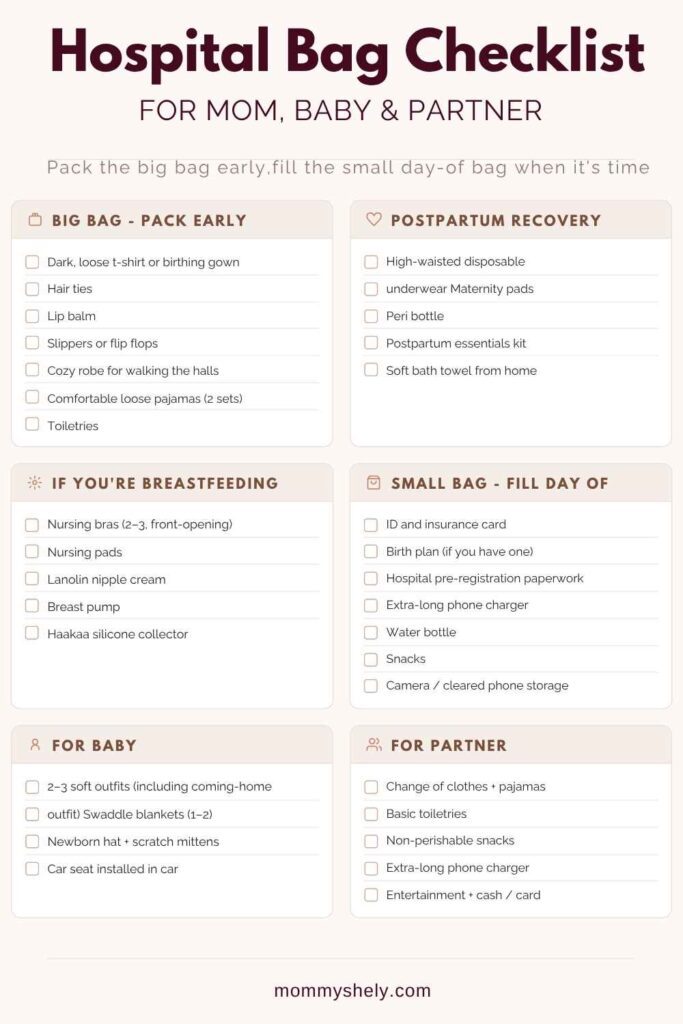
Free Printable Hospital Bag Checklist
Packing your hospital bag is one of those tasks that feels bigger than it is. Once it’s done there’s this huge exhale – okay, I’m ready. And you are.
And just to make it even easier – I put together a free printable checklist with everything from this post, organized by category and ready to print. Stick it on your fridge, tuck it in your bag, or check things off as you pack.
If you want to keep reading, my post on what they don’t tell you about childbirth is a good next stop. Because knowing what to expect on the other side of that hospital door? That’s the real preparation.
With love,
Shely